Non-Metallic Fabric Belt Selection for Expansion Joints: Materials, Configurations, and Application Guidance
1. Introduction
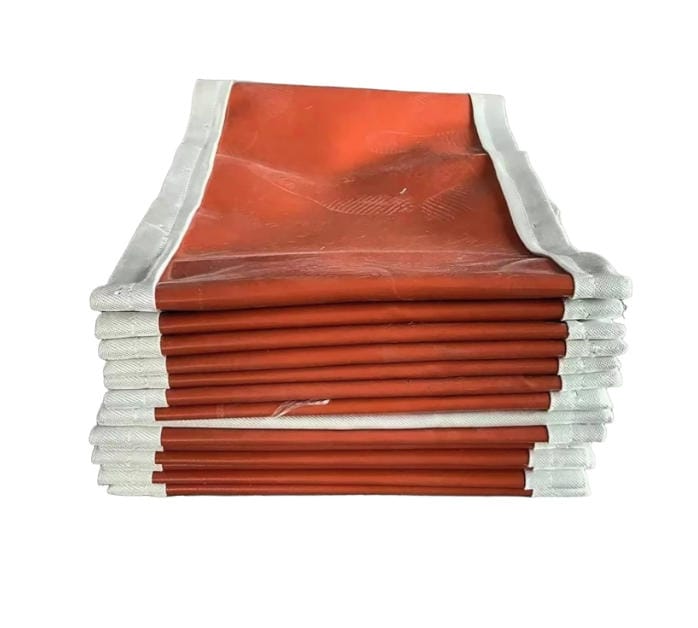
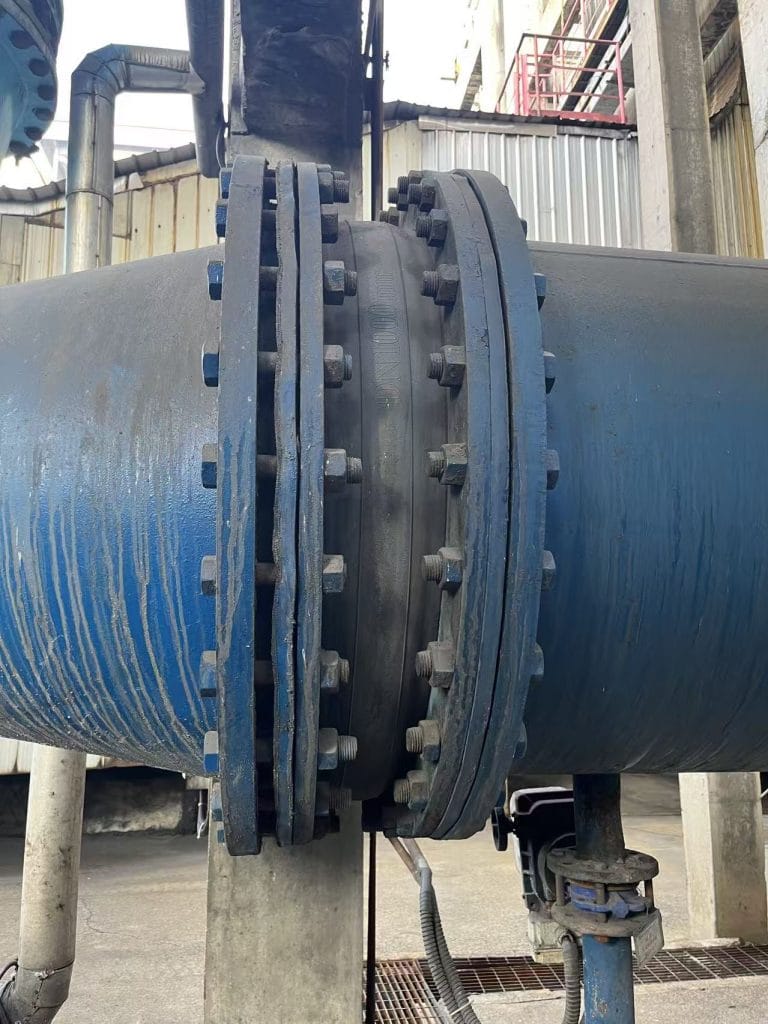
Non-metallic expansion joints rely on a flexible sealing element — often referred to as a fabric belt, composite fabric belt, or, in maintenance contexts, a replacement fabric belt — to accommodate thermal growth, vibration, and misalignment in ductwork and flue gas systems. This component is also commonly called an expansion joint fabric skin (or simply joint skin), a flat fabric belt, or a flexible fabric diaphragm, depending on the industry and region.
Unlike metallic bellows, these multi-layer fabric assemblies offer superior corrosion resistance, lower reaction forces, and the ability to absorb simultaneous axial, lateral, and angular displacements. However, their performance is entirely dependent on correct material selection. The following sections provide a technical framework for specifying the right composite fabric belt based on operating temperature, chemical exposure, and mechanical requirements.
2. Material Families
Fabric belts for non-metallic expansion joints fall into two broad categories based on the elastomer system:
2.1 Silicone Coated Fabric Belt
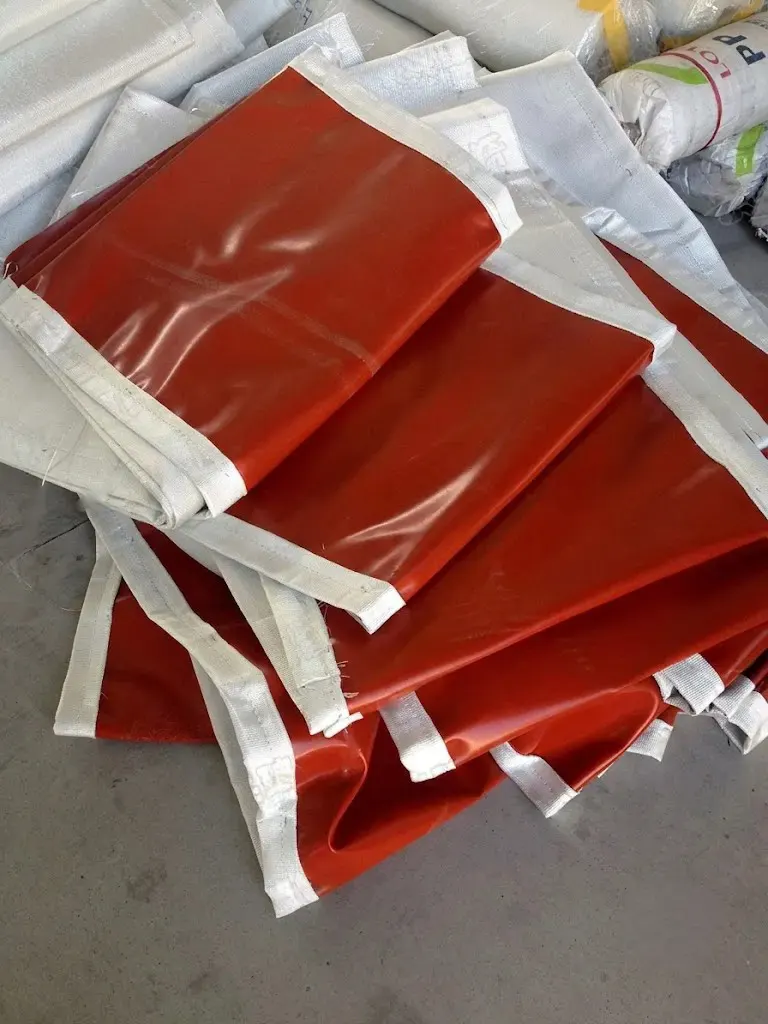
Silicone-coated fiberglass belts are the economical workhorse for moderate-temperature applications. The silicone rubber compound provides excellent UV and ozone resistance, making these belts suitable for outdoor installations with 10+ years of weathering life.
- Continuous service temperature: -70 °C to 230 °C (up to 600 °C with internal insulation)
- Typical reinforcement: Steel-wire-reinforced fiberglass cloth
- Best suited for: Air ducts, low-pressure flue gas, mildly corrosive environments
2.2 Viton / FKM Fabric Belt (Fluoroelastomer)
For elevated temperatures and aggressive chemical environments, fluoroelastomer (Viton / FKM) belts are the standard choice. The fluorine-based polymer provides inherent resistance to acids, hydrocarbons, and oxidizing media.
- Continuous service temperature: up to 1,000 °C (with ceramic fiber insulation)
- Typical reinforcement: Stainless steel wire mesh + fiberglass cloth
- Best suited for: Denitration (SCR/SNCR) ducts, FGD absorber inlet/outlet, chemical plant gas lines
When a fluoroelastomer belt incorporates an internal PTFE film layer, it is often specified as a PTFE lined fabric belt. The PTFE barrier provides near-zero permeation against acid condensates — a critical requirement in wet flue gas desulfurization service where sulfuric, hydrochloric, and hydrofluoric acids are present.
3. Layer Construction
The term composite fabric belt reflects the multi-layer construction typical of these products. A standard 7-layer stack might consist of:
| Layer (outside → inside) | Material | Function |
| 1 | Stainless steel wire mesh, 20-mesh × 0.2 mm | Abrasion shield, particulate erosion resistance |
| 2 | Fluoroelastomer or silicone composite cloth, 1.5 mm | Primary gas seal, chemical barrier |
| 3 | PTFE fabric, 0.25–0.3 mm | Chemical permeation barrier |
| 4 | Steel-wire-reinforced fiberglass cloth, 1.2 mm | Structural strength, pressure containment |
| 5 | PTFE fabric, 0.25–0.3 mm | Secondary permeation barrier |
| 6 | Steel-wire-reinforced fiberglass cloth, 1.2 mm | Structural strength |
| 7 | Fiberglass cloth or fluoroelastomer inner liner, 1.0–1.5 mm | Internal gas-tight seal |
Total belt thickness ranges from 8 mm to 20 mm depending on the number of layers and the presence of an internal insulation bolster. Belts incorporating ceramic fiber blankets for high-temperature service may reach 25–30 mm.
4. Application-Specific Configurations
4.1 Flue Gas Ducts (250–350 °C)
For conventional power plant and cement plant flue gas ducts, a silicone coated fabric belt with the following build-up provides reliable service:
- 20-mesh 304 SS wire mesh, 0.2 mm
- Silicone rubber composite cloth, 1.5 mm
- PTFE fabric, 0.25 mm
- Steel-wire-reinforced fiberglass cloth, 1.2 mm
- PTFE fabric, 0.25 mm
- Steel-wire-reinforced fiberglass cloth, 1.2 mm
- Fiberglass cloth, 1.0 mm
When operating near the upper limit of 350 °C, an internal 20 mm insulation blanket should be added to keep the elastomer layers within their rated range. This configuration essentially converts the belt into a high temperature fabric belt without changing the elastomer chemistry.
4.2 Denitration Systems
SCR and SNCR denitration ducts expose the belt to ammonia, nitrogen oxides, ammonium bisulfate deposits, and temperatures that can exceed 400 °C during soot-blowing cycles. The recommended Viton / FKM fabric belt configuration is:
- Stainless steel wire mesh, 20-mesh × 0.2 mm
- Fluoroelastomer composite cloth, 1.5 mm
- Steel-wire-reinforced fiberglass cloth, 1.2 mm
- PTFE fabric, 0.3 mm
- Steel-wire-reinforced fiberglass cloth, 1.2 mm
- Steel-wire-reinforced fiberglass cloth, 1.2 mm
- Needle-punched ceramic fiber blanket, 10 mm
- Wire-reinforced ceramic cloth, 2.0 mm
This stack functions as both a high temperature fabric belt (ceramic fiber + wire-reinforced ceramic cloth on the hot face) and an acid resistant fabric belt (fluoroelastomer outer layer + PTFE barrier against nitric acid condensates).
4.3 Desulfurization (FGD) Systems
Wet FGD absorber ducts present the most chemically aggressive conditions in a thermal power plant. The standard configuration uses a PTFE lined fabric belt with symmetrical construction:
- Fluoroelastomer composite cloth, 1.5 mm
- PTFE film, 0.3 mm
- Fiberglass cloth, 1.2 mm
- PTFE film, 0.3 mm
- Fiberglass cloth, 1.2 mm
- Fluoroelastomer composite cloth, 1.5 mm
The dual PTFE film layers form a redundant barrier against mixed acid condensates. The symmetrical fiberglass fabric belt core provides dimensional stability and prevents curling or warping under thermal cycling.
5. Replacement Considerations
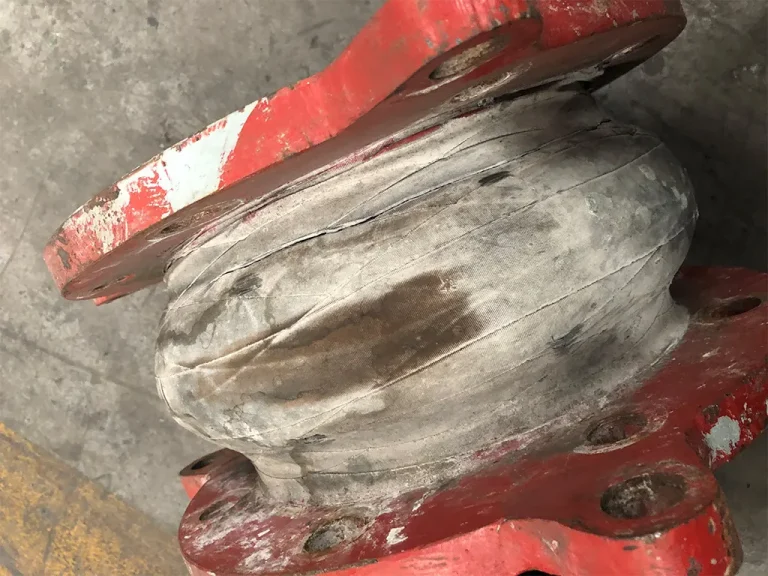
In many cases, the steel frame and clamping system of an existing expansion joint remain serviceable while only the flexible element has degraded. Specifying a replacement fabric belt — also called a joint skin by maintenance teams — is significantly more economical than replacing the entire assembly.
Indicators that a replacement fabric belt is needed:
- Cracking, delamination, or surface blistering of the elastomer
- Visible gas or dust leakage through the belt body
- Acid staining indicating chemical attack on the outer layers
- Stiffening of the flexible fabric diaphragm, reducing its ability to compensate for movement
- Bolt-hole elongation or tearing near the clamping zone
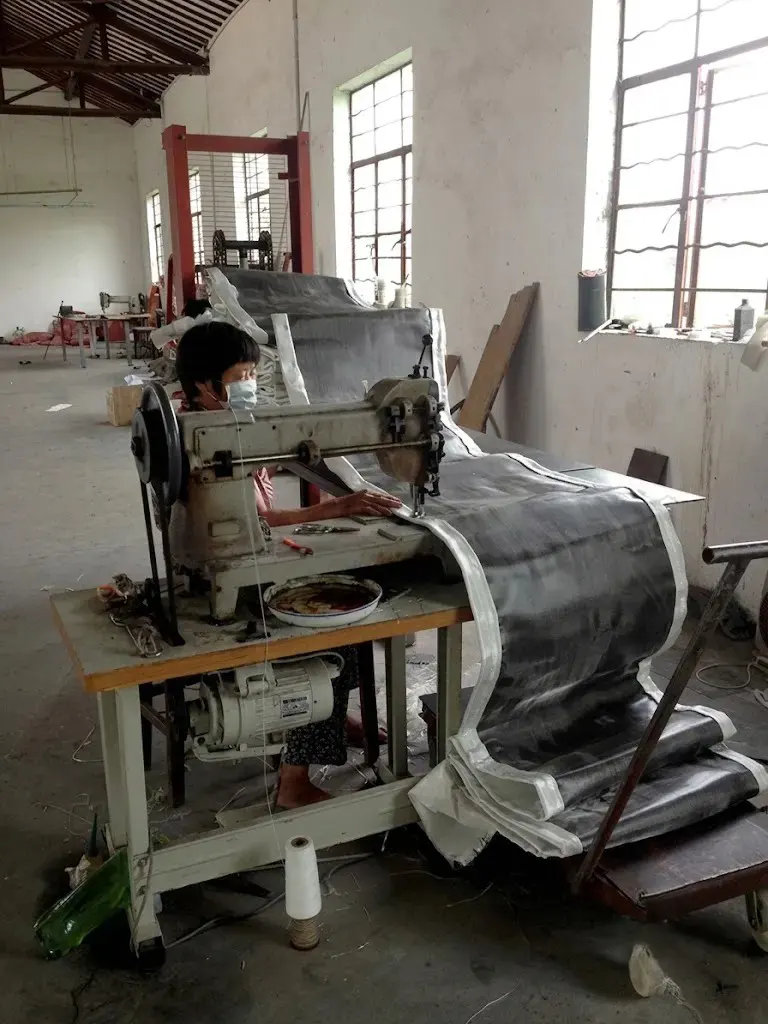
A properly specified replacement fabric belt should match the original bolt pattern, corner radii, and overall dimensions. Henan Devel Fluid fabricates replacement belts from customer-provided drawings or field measurements to ensure drop-in compatibility.
6. Key Specification Parameters
When specifying a fabric belt — whether for a new installation or as a replacement — the following parameters must be defined:
| Parameter | Typical Range | Notes |
| Continuous operating temperature | 150–1,000 °C | Determines elastomer type and insulation requirements |
| Pressure | ≤ 0.5 MPa | Higher pressures require thicker cross-sections and closer bolt spacing |
| Axial compensation | ±50–±300 mm | Depends on belt width and geometry |
| Lateral compensation | ±30–±150 mm | Requires sufficient belt slack |
| Angular compensation | up to 30–40% of effective length | Function of belt width and frame design |
| Chemical exposure | pH 1–14 | Dictates elastomer chemistry and PTFE barrier requirement |
| Particulate loading | g/m³ | Determines wire mesh gauge and placement |
| Duct dimensions | DN100–DN5000 (circular) / custom rectangular | Custom-fabricated to drawing |
7. Summary
The non-metallic fabric belt — whether called a composite fabric belt, expansion joint fabric skin, flat fabric belt, or flexible fabric diaphragm — is a precision-engineered sealing component whose performance depends on matching material chemistry and layer configuration to the specific operating environment. Silicone coated belts serve moderate-temperature, cost-sensitive applications well. Viton / FKM and PTFE lined fabric belts are required for high-temperature, chemically aggressive service. And when existing joints need refurbishment, a properly specified replacement fabric belt offers a cost-effective alternative to full assembly replacement.
For project-specific technical consultation or a quotation, contact the engineering team at Henan Devel Fluid Equipment Co., Ltd.
👉 Fabric Belt for Non-Metallic Expansion Joints — Product Page